Wednesday, April 27, 2011

Two Oceans

Over Easter weekend, I ran the Two Oceans Half Marathon. It is advertised as the most beautiful race on Earth, and I 100% agree! The race started at 6:00am in Newlands and went along the Main Rd in Claremont. After about 5 miles, the sun started coming up and we were running in a residential area with a beautiful view of the mountains. That is, it was beautiful until I realized that I would be running up the nearest one! As soon as we were out of Claremont, the road was winding up the mountain and was lined with these huge, beautiful evergreens. I had contemplated running with my camera, and this was one section of the race that I wish that I had. The incline was pretty steep and lasted about 2 miles, but it was nowhere near as terrible as I thought it would be. Plus, the rest of the race was downhill so I was really able to pick up the pace (although my joints regretted it later)!

The energy in the race was amazing. There were African drummers along the route as well as a few DJs and cheerleading squads. There was also tons of support from the crowds and the 14,000 other runners who were doing the half marathon. International runners have different bib colours, and a lot of other international runners introduced themselves during the run. I met a few people from Brazil as well as Namibia and Zimbabwe.

After the race, my knees started to cramp up and I ended up limping around town for the rest of the day. I was absolutely amazed when I saw the ultra marathon runners, who had run 56k, or about 33.6 miles, strolling around town without looking tired at all! This was also the first year in about 30 years that a South African won the ultra marathon, so there was a lot of patriotism from the South Africans that day.


Before the race, we got supporter signes made at the expo..this one says 'Nobody made you do this Amanda' and the other one says 'Run like someone is chasing you'.


Elite runner finishing the ultra marathon.


Tuesday, April 12, 2011

Bo-Kaap and Downtown

On Saturday we had a house trip that ended up being a tour of downtown Cape Town and Bo-Kaap. We started out at the Castle, which was originally built between 1666 and 1679 by the Dutch East India Company and is the oldest building in South Africa. The Cape was a strategic point because ships needed a place to stop for food and water on the way to India to trade for spices and other goods. The Dutch built the castle to defend it from the threat of a British attack.

The flags represent the different eras of South Africa's history: Dutch rule under the Prince of Orange, British rule, Dutch rule again, British rule again, Apartheid rule, and the current democratic South Africa.

We also walked past the Cape Town City Hall, where Nelson Mandela made his first speech after he was released from Robben Island.


Although most people think of slaves as having been captured from the west coast of Africa and being brought to the Americas, slavery was also an important part of Cape society during the colonial period. The Dutch were ordered not to enslave the local population in the interest of preventing conflicts, so many slaves were imported from India, Sri Lanka, and Malaysia. Today, their descendants are broadly know as Cape Malays. Along the way, we stopped in at the slave lodge, which is now a museum.

By the time we made it to Bo-Kaap, it was super hot outside! Bo-Kaap is a neighborhood that was originally built to house soldiers but instead was used to house the descendants of former slaves who lived in the Cape Town area. During the apartheid era, everybody who was not classified as a Cape Malay was forced to move out of the area, but now it is known for its beautiful houses!


Pictures of my homestay in Ocean View


Leigh by the tyre repair sign...my host dad Neville has a shop in his garage.

Sign to Ocean View

The delicious seafood dinner caught by Neville!

My host sister and mother, Nicole and Luzanne, and I at Kaulk's Bay.

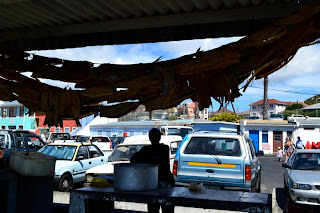
Fish being hung to dry.


Fall Break in Cape Town.


Last week we had time off from classes for fall break, otherwise known as vac. I had a nice time staying in Cape Town and catching up on homework, although I didn't get to visit any museums, which had been one of my priorities. However, I did get the chance to go for unlimited ribs and prawn with some of my Zimbabwean friends at a restaurant called Aqua, which was fun but also complicated since we forgot to print out our vouchers before we came and had to find a place with free wireless so we could pull them up on the computer screen for the manager. But the food was good, we ate up the rest of the restaurants ribs, and the waiter was nice and let us take doggy bags even though we weren't supposed to. Apparently, there was also a South African movie star at the restaurant. Afterward, we stopped by a salsa club to watch the more accomplished dancers. Ngoni tried to teach me the basic steps, but I definitely couldn't compare to the awesome dancers who were there.

On Wednesday, Quinton, the CIEE program coordinator, surprised us by taking the people who were left in Cape Town on a safari. We went to a game reserve called Fairy Glen. Since it is a game reserve it is much smaller than a national park. The more common animals like Springbok and Zebras are bred on the reserve while the protected species like rhino and lions have to be bought and are usually rescued animals or animals that caused problems in the national park and would have otherwise been put down.

I was surprised at myself for actually being intimidated by some of the animals. We first saw two rhino, who seemed pretty tame until our guide told us that there used to be a hippo on the reserve until it got in a fight with the rhino. Apparently, when the hippo opened its mouth to bite the rhino, the rhino gored it in the roof of its mouth and actually lifted it off of the ground!


Rhinos are endangered because their horns can be sold for a lot of money in Asia where people think that ground horns can cure cancer. Horns are usually about 7 kgs and are worth $36,000 per kg.

We were also able to see some giraffes. According to our guide, giraffes are unable to lay down for long periods of time or to sleep because they need to keep high blood pressure to get blood from their hearts to their brains.


I found the buffalo to be the most intimidating because one of the buffalo we saw had mauled our guide on the reserve about a year ago. It was also aggressive when we drove by, and ended up trying to charge the vehicle!


The elephant was my favorite animal. Elephants eat and destroy about 3 tonnes of vegetation a day, so they constantly have to be planting more trees on the reserve. This elephant had lived in Kruger National Park, but was going to be put down because it had a habit of damaging fences and buildings in the parks. Since the animals on the game reserve are somewhat protected and don't really need to defend themselves, the reserve was able to take in the elephant and cut off its tusks so that it wouldn't be able to damage the property. This one was busy uprooting a tree when we drove by...


Lastly, we saw the lions. They were a sad story because they were rescued from captivity and could not be released into the wild because they never learned how to hunt.


P.S. All of the pictures are courtesy of Farai because I forgot my camera. Thanks!

Thursday, March 17, 2011

Ocean View

This past weekend, I experienced some real South African hospitality during my home stay in Ocean View. Ocean View is a township that is a 10-15 minute drive from Fishhoek and Simons Town--two beautiful beach neighborhoods. In the 1960's-1970's the coloured residents of Fishoek and Simons Town were forced to relocate to Ocean View when these areas were classified as white-only. Today the community is almost all coloured (that is what mixed race people or Cape Malays are called in South Africa) and most people speak both English and Afrikaans.

Although many people will tell you that Ocean View is dangerous, I really enjoyed my time in the community. My host parents and their two children went all-out to make sure that we were able to experience the area. My host dad, Neville, is a commercial fisherman, which I thought was fascinating. He fishes using nets and fishing lines, but also free dives to catch prawn and lobster. He told me that he can hold his breath for about four and a half minutes! He alternates between fishing and running a tyre repair shop from his home during the week.

Luzanne, my host mother, and Neville took us to a fish market on the coast and on a tour of the peninsula. It was BEAUTIFUL, but unfortunately I forgot to bring my camera. We also visited a farm where we saw camels (they are huge!!!) and watched the Cape Argus bike tour, a 110 km race that is one of the biggest in the world.

Luzanne was an amazing chef. She and Neville treated us to an awesome seafood dinner with snoek, calamari, prawn, and other fresh seafood that Neville caught himself. Luzanne also taught me how to cook lamb and gave me a special baked vegetable recipe.

My time in Ocean View was an amazing experience, and it was hard to say goodbye. I learned so much about the culture and history of Ocean View, which gave me so much appreciation for Cape Town as a whole. I can't wait to continue my explorations!

Wednesday, March 16, 2011

Robben Island


Recently, my study abroad program took us on a trip to Robben Island, where many political prisoners were held during the Apartheid era. It was amazing to realize the extent to which the prisoners were able to rise above their circumstances and unite despite the inhumane conditions at the prison.

Robben Island has a history of housing outcasts. During the colonial era, the island was used as a quarantine for people with leprosy, but the only things on the island that remain from that period in time are a church and a graveyard. Everything else was burned to prevent the spread of the disease.


More recently, Robben Island was used to hold political prisoners during the struggle against Apartheid.


This is Nelson Mandela's prison cell. He was given three blankets to sleep on, but no bed. The bucket in the picture was used for washing clothes, as a toilet, and to carry drinking water back to his cell in. After work, the prisoners were given a limited amount of time to visit before they were locked into their cells, which they would use to play chess, exercise, or talk about political strategies.

The Apartheid government created racial classifications in order to divide the oppressed and create factions. For example, Indians, mixed race and Cape Malay (called coloureds), and blacks were given different privileges to create resentment for those who had more and a sense of superiority over those who were given less. This was not any different at Robben Island. Coloureds were given more food and clothing than blacks, who were not even allowed to wear underwear. Our tour guide, who was a former prisoner on the island, explained to us that they were very conscious of these racial divisions and demonstrated unity by dividing everything they ate and owned equally.


During the day, the prisoners were forced to mine sandstone. The quarry was directly in the sun, and today many of the former prisoners, including Nelson Mandela have damage to their eyes from the glare. At first they were forced to mine the rocks all day, but when the older guards were replaced with younger and more liberal guards, they were able to form an agreement. Instead of mining, the more educated prisoners would teach the prisoners who had not had a formal education while the guards would act as lookouts. In this way, many of the prisoners who arrived at Robben Island illiterate had the equivalent of a college education when they were released.

The sandstone quarry where prisoners worked during the day.


Thursday, February 10, 2011

Bikes, wine, museums, and cheetahs


This past week is the last week that we have before classes start, so I’ve been trying to do as many things as possible in case I don't have time once classes start.


On Sunday, the residence hall sponsored a trip to the beach, which was beautiful but crowded. I thought it was interesting that since sharks are such a big problem in South Africa, the African government has hired shark watchers to make sure that the beaches are safe. The shark watcher sits on a mountain or a high chair like a lifeguard and watches the water for any signs of sharks. If a shark is spotted near the beach then a flag is flown so that people know to stay out of the water.


On Tuesday, a group of people from my study abroad program went downtown to see what was going on. We found the South African museum, a museum that is similar to the Natural History Museum in DC and mostly focuses on early African history. My favorite exhibit had rock drawings that are 2,000 or more years old!


While we were downtown we also explored Long Street. At night Long Street is the place to go out because it has a lot of clubs, restaurants, and bars, but during the day there are a lot of shops that sell African things. My roommate Rohanna found a neat African mask and bargained it down from R350 to R100, which was pretty impressive! Even though I didn't buy anything, I had a lot of fun talking with the shop owners. Most of them were from Kenya or Zimbabwe. In fact, I've only met a handful of South Africans while I've been here because almost everybody here seems to be Zim!

Popular fabric choices at the market.....

On Wednesday, our RA Farai took us to Simon’s Town. Simon’s Town is a small area by the Indian Ocean with beaches and sea food restaurants, and it is also home to the South African Navy. The South African Navy is the largest navy in Africa and is proud of its two submarines, but it is only a fraction of the size of the U.S. Navy. We visited the Naval Museum, which was really cool. They had replicas of all of the ships in the navy as well as old cannons, missiles, and part of an old submarine. At the museum, there was a flag with a swastika displayed next to a sign that read, “South Africa seconded to the British Royal Navy”. We found out that South Africa had been divided between those who supported the British and those who supported the Germans during WWII. Since there was strong support for both sides, the South African Navy fought for both the Allies and the Axis.


Today I did a biking and wine tasting tour with the travel agency on campus. We left early in the morning and took a train to Stellenbosch, the section of Cape Town with vineyards. It was amazing! We first biked to Van Ryn’s, a brandy distillery in the area. There, we learned the proper form for tasting brandy and got to try the 10 and the 15 year fine cask reserve, which won the International Spirits Challenge and has been named the best brandy in the world!


From there we had a short bike ride to a winery where we ate lunch and sampled wine. We then had a 3-mile bike ride to the next winery. It was amazing since we were able to bike through the vineyards and the African brush. Many of the native plants in the brush are thought to be related to sea corals, since the area was once underwater.

The last winery that we visited was on the Moyo estate, the same place where our study abroad dinner was held. Aside for a restaurant and a winery, the estate has a cheetah and a raptor rehabilitation center. The cheetah we met was supposedly in a movie with Patrick Swayze!


Even though Monday is our first official day of classes, there is an official ‘practice run’ tomorrow. I was confused at first about what we were supposed to do, especially because the RA’s had no idea what we were talking about. Later I found out that even though everybody is supposed to attend the ‘practice run’ so that the lecturers can make sure that the space is big enough to accommodate everybody, usually only the American exchange students show up!